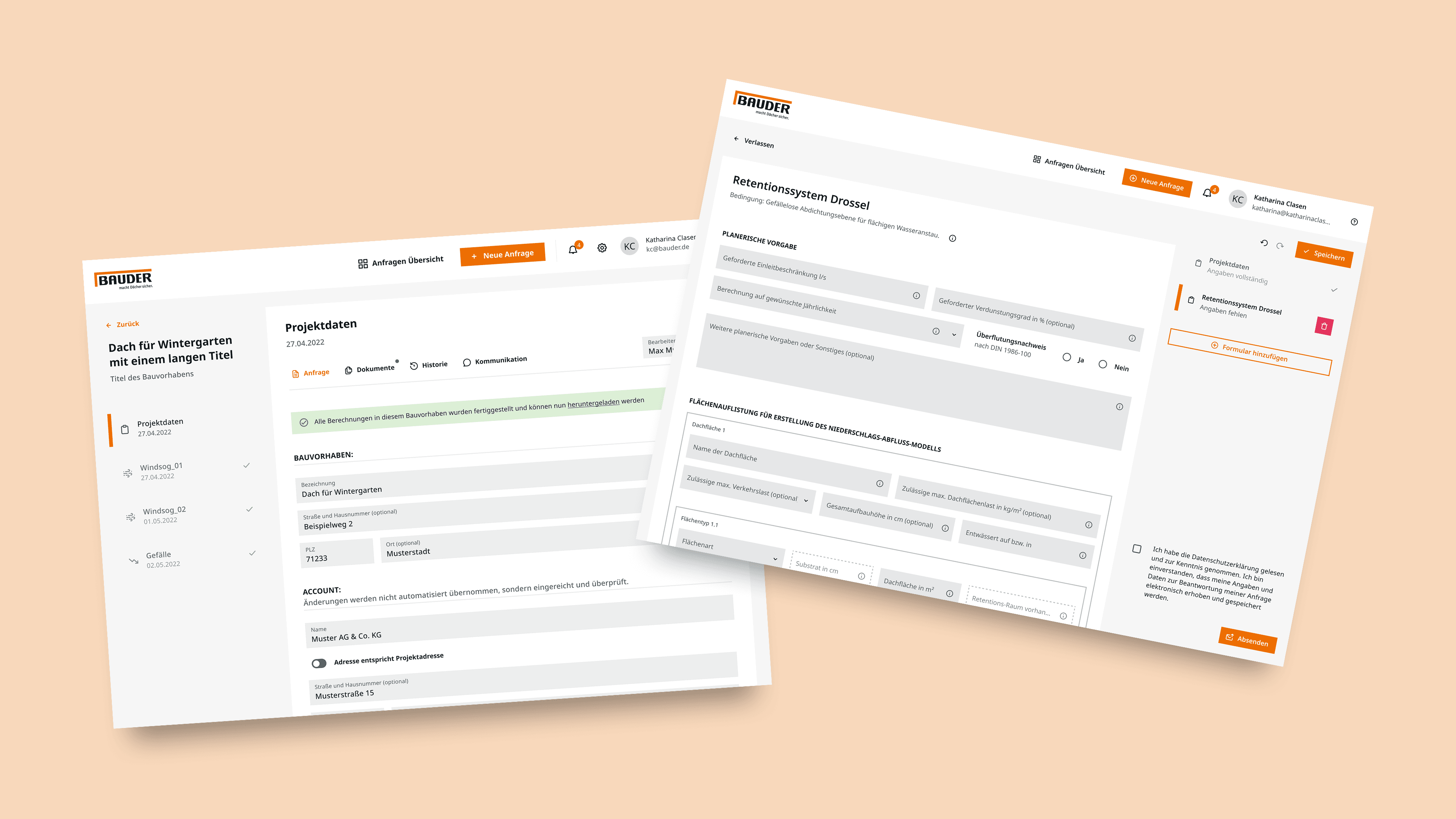
HIDDEN: Bauder Service Requests
📌 Project overview
Client: Paul Bauder GmbH & Co. KG
Industry: Roofing Solutions / Construction
Team: Product Owner (internal), Development Team (external), Scrum Master (external), UX Designer (my role)
Bauder is one of Europe’s leading providers of advanced roofing solutions, with over 165 years of experience. The company offers products ranging from waterproofing and thermal insulation to green roofs and photovoltaics. With 1,500+ employees, seven production sites in Germany, one in Austria, and subsidiaries in 18 countries, Bauder continues to set standards in sustainable, future-oriented roofing.
❌ Problem statement
Bauder strives to provide an outstanding customer service experience. That is why the company offers a wide range of roof planning services – free of charge.
To deliver these services, customers need to share details about their projects with Bauder. This includes information on roof specifications and required products. On the other side, Bauder technicians need quick and reliable access to this data to plan materials accordingly.
In the past, this process relied on static PDF forms. Customers either filled out the forms themselves and sent them to their Bauder consultant or provided the information by phone, while the Bauder employee completed the form on their behalf.
Key issues of the old workflow:
- Static PDFs could not adapt to material or roof configuration specifics
- Requests came in via multiple, unstructured channels (phone, email, PDF)
- No integration with existing or new Bauder digital tools (e.g., roof planner, CRM)
- Customers lacked transparency – they couldn’t track the status of their requests
- Employees struggled with inefficiency and poor data consistency
🎯 Goals & objectives
Bauder set out to digitize the service request process to achieve:
- ✅ Simpler and more transparent request submission for customers
- ✅ Real-time status tracking
- ✅ Streamlined workflows for service agents and technicians
- ✅ Seamless integration into Bauder’s digital ecosystem (CRM + Roof Planner)
- ✅ Consistent user experience across all touchpoints
👩🏻💻 My role & responsibilities
As the UX Designer, I was responsible for:
- User Research, Discovery
- Understanding needs of external clients, customer service agents, and technicians
- Product Definition
- Translating business goals into product requirements with the product owner
- UX & UI Design
- Creating user flows, wireframes, and mockups
- Validation, (Usability) Testing
- Running usability tests and iterating on feedback
- Collaboration
- Working closely with the dev team to ensure feasibility
- Active participation in Scrum events
🛠️ Challenges & design considerations
1. Multiple user groups
- Clients: want to submit and track requests easily
- Customer Service Agents: want to manage communication, ensure timely delivery, and track customer lifecycle
- Technicians: need all relevant data at hand to fulfill services efficiently
2. Tailored functionality, consistent experience
Different user groups require different features, but the tool still has to feel intuitive and consistent.
3. Change management & user acceptance
Shifting from PDFs/phone calls to a digital tool required clear value for users – the system had to be noticeably better than the old process.
4. Integration into the digital ecosystem
The service request tool only reached its full potential when connected to:
- Existing CRM ecosystem
- The new Bauder Roof Planner
👉 Outcome & impact
✨ For customers:
- Easy online request process
- Transparent status tracking
- Faster turnaround
✨ For Bauder employees:
- Centralized and structured data
- Less manual effort and redundancy
- Improved cross-team collaboration
✨ For Bauder’s digital Ssrategy:
- Stronger integration of tools
- Foundation for scalable future services
- Enhanced customer satisfaction and brand value
💭 Learnings & reflections
- Designing for multiple user groups requires balancing specific needs with overall simplicity
- Change management is critical: users must see immediate value to adopt a new tool
- Integration across services multiplies the impact of good UX Design beyond a single touchpoint